

RISC-V Summit Europe was a landmark event for me. It was my first in-person opportunity to showcase AiNekko to a community I feel deeply connected to, and to have real conversations around the work behind Erbium and core-et.
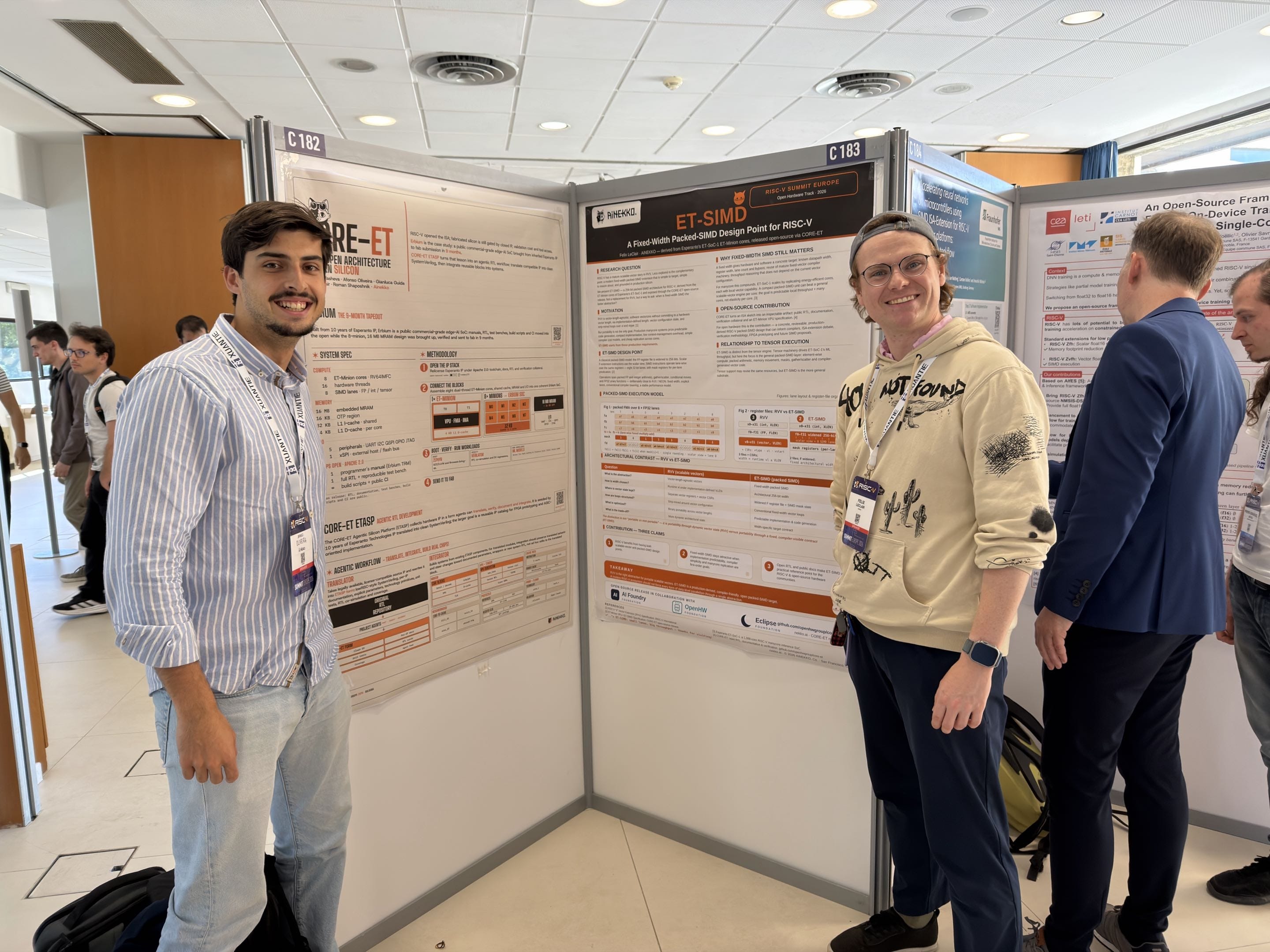
With three posters and a talk, our goal was simple: show who we are, what we have built, and where we are headed next.
The RISC-V landscape has matured
My broader takeaway from the summit was clear: RISC-V is maturing, with silicon now genuinely accessible across vendors. Standardization has advanced too, with RVA23 establishing a solid baseline for general-purpose CPUs and distributable software.
While acquisitions have reduced the diversity of players, we are now at a point where it feels fair to say that commercial RISC-V has arrived. Products are reaching the market at an accelerating pace, and walking through the booths made that momentum feel very real.
My first time presenting AiNekko to the community
For me, this was the first time showcasing AiNekko to the RISC-V community in person, and I was ready to bring the energy.
Sharing the journey behind our 9-month tapeout, Erbium, was especially exciting. Many of the questions focused on how we approached the acquired IP, how we worked to understand and develop it, and what it took to align a team around a fast-moving tapeout schedule.
But what really captured people’s attention was where we are headed next.
Earlier this year, we open-sourced core-et, our agentic silicon platform. core-et is our agentic workflow for SoC development, currently spanning RTL to DV. Through its structure and building blocks, it showcases how orchestration, repository organization, and detailed documentation can come together to support agent-driven development. From translator agents to integrator agents, the workflow points toward a new paradigm for RTL design.
Agentic RTL development was naturally an interesting topic of discussion at the summit. While there is broad agreement that AI has transformed software development, RTL remains an active area of research, and our approach sparked plenty of questions. Many of those conversations centered on what agents can realistically do, how much of the workflow can be trusted, and where engineering judgment still matters.
Walking away from the summit, one thing felt clear: RISC-V is entering a more mature commercial phase, while new development workflows are beginning to challenge how silicon itself gets built. That shift raises important questions about the future of hardware engineering, automation, and the role of human judgment in the design process. Being part of AiNekko makes me confident that we are not just building that future take shape, we are at it’s leading edge.